Home / Services / Installation
Palm Bay Landscape Lighting installs new low-voltage outdoor lighting systems for homes in Palm Bay, West Melbourne, Melbourne, Malabar, and nearby Brevard County neighborhoods. New installations are designed around your specific yard — path lighting for walkways and driveways, uplighting for palms and oaks, wall grazing on entry walls, address and entry lighting, and accent lighting for pool decks and outdoor living areas. Fixture count, placement, wire runs, and transformer sizing are worked out during a short on-site design visit before any pricing is set, so the quote reflects the real scope of your yard rather than a template price.
A residential low-voltage system is more than a set of fixtures. Here's what actually goes into a proper installation in Palm Bay.
Most new installation calls in Palm Bay come from one of a few situations.
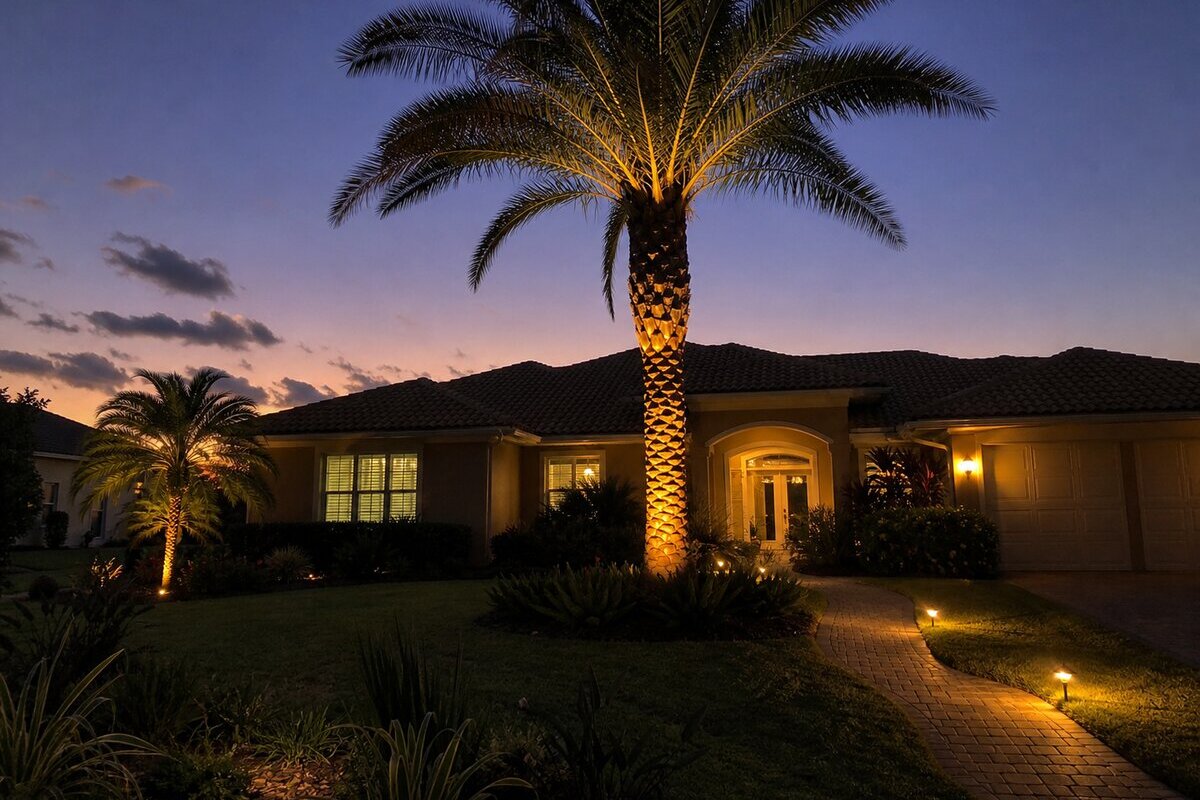
Installation prices vary because yards vary. These are the factors that move the number the most.
Every installation quote follows a short on-site design visit — the only way to price fixture placement, transformer sizing, and wire runs accurately.
Call or send the callback form. Mention what you want lit — front, back, pool area, trees — and anything about access or timing.
A short walk of the property in daylight to plan fixture placement, transformer location, and wire runs. Nothing gets installed at this visit.
You get a written scope and price. If it looks right, installation is scheduled. Most residential installs are one to two days on-site.
Yes, and it's a common approach. Many homeowners start with the front walkway and entry, then add backyard, pool area, or tree lighting later. The key is sizing the transformer and main wire runs for the full plan up front so later zones connect cleanly instead of requiring a second system.
New installations use LED lamps and drivers. LEDs draw a fraction of the power of the halogens they replaced, run cooler inside the fixture, and last far longer between changes. That combination is why LED is now the default for both new installs and older-system conversions.
Yes. Systems are controlled by a photocell that senses dusk, an astronomical timer that tracks sunset and sunrise by date, or a smart-home controller. Most homeowners choose dusk-to-dawn, dusk-to-a-set-hour (like 11 p.m.), or a combination.
Low-voltage wire is buried shallow in planting beds — typically 4–6 inches deep — and slit into the edge of sod for path runs. Trenching is limited to what's necessary to cross walkways or driveways. Most yards look normal within a week.
Most single-family installations are one to two days on-site, depending on fixture count and access. Very large or complex designs can run longer. That estimate is confirmed as part of the quote.
Call for repair questions or a quick scope conversation, or send the callback form for installation and design work.